
Dispensing Technology for Fuel Cell and Electrolyzer Manufacturing
Precise Dispensing Technology as a Key Enabler for Scalable Fuel Cell Systems
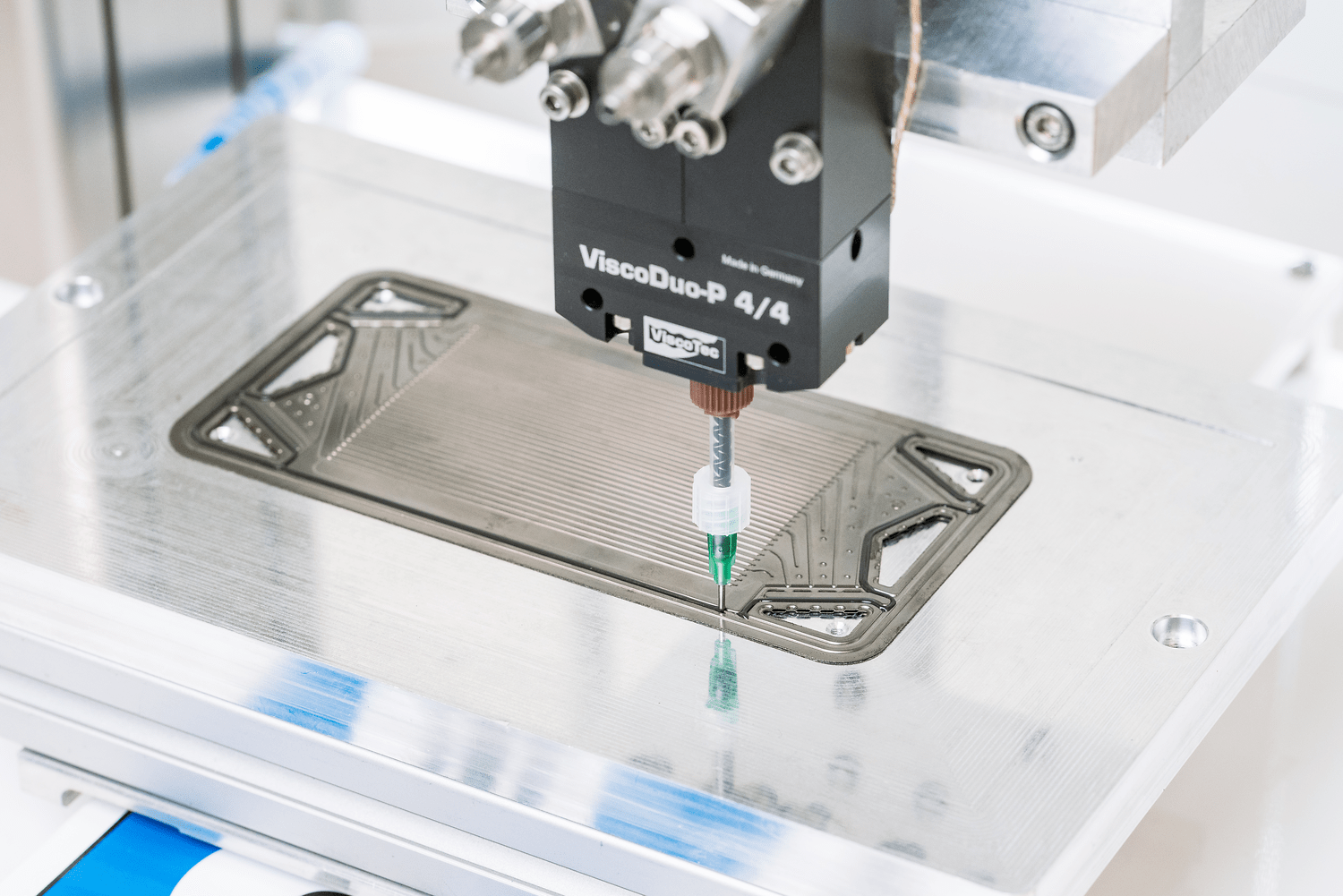
The economic scaling of fuel cell and electrolyzer manufacturing depends heavily on stable, automated production processes. Particularly in the application of adhesives, sealing materials, and functional coatings, dispensing technology plays a critical role in determining product quality, performance, and manufacturing efficiency. At the same time, increasing production volumes place high demands on precision, repeatability, and process reliability.
ViscoTec supports manufacturers in meeting these requirements with highly precise dispensing solutions. The modular system design enables accurate material feeding and seamless integration into automated production lines. The result is stable processes, reproducible dispensing results, and the foundation for cost-effective series production.
Fuel Cells: A Mature Technology for Stationary and Mobile Applications
Fuel cells are among the key technologies driving the energy transition. As highly efficient electrochemical energy converters, they are used today in stationary power and heat generation systems as well as in mobile applications across the rail, commercial vehicle, automotive, aerospace, and aviation industries.
Mobile applications, in particular, place extremely high demands on the components involved. Mechanical stress, challenging operating conditions, and frequent start-stop cycles require consistently high process and product quality. To meet these demands, manufacturers need production processes that combine maximum precision with repeatable results and a high degree of automation.
Application of Adhesive and Sealing Beads
Consistent and highly repeatable application of adhesive and sealing materials is essential for the functionality, performance, and service life of fuel cells. Many dispensing technologies reach their limits when processing complex geometries, such as bipolar plates, or highly filled and abrasive materials.
A key application in fuel cell manufacturing is the dispensing of defined adhesive and sealing beads. Typical materials include glass solder pastes with a high filler content and abrasive glass particles. These materials place demanding requirements on the dispensing system:
- Extremely high viscosities
- High material densities
- Significant abrasive potential
- Highly repeatable application of sealing materials
- Consistent bead geometry across the entire application path
ViscoTec dispensing pumps are specifically designed for these demanding operating conditions. Low-shear material handling, wear-optimized materials, and optional ceramic rotors ensure long-term stable and precise dispensing performance.
The application process is pulse-free and highly repeatable, resulting in consistently high sealing quality. This is a crucial factor in ensuring the operational reliability and longevity of the fuel cell.
To further optimize the process, material preparation systems can be integrated. Functions such as stirring, recirculation, and vacuum degassing ensure consistent material quality and reliably prevent filler sedimentation. The result is stable processes, reproducible dispensing performance, and high manufacturing reliability, even in automated high-volume production environments.
Continuous Membrane Coating (MEA Manufacturing)
In addition to adhesive and sealing applications, dispensing technology is also used in the production of the Membrane Electrode Assembly (MEA), the functional core of many fuel cells.
During continuous manufacturing processes, catalyst-containing pastes for the anode and cathode are applied evenly to proton-exchange membranes (PEM). Precise control of the material application is essential for the performance and quality of the finished fuel cell.
Using slot dies, low- to medium-viscosity catalyst pastes can be applied uniformly and with a consistent coating width. Volumetric dispensing ensures consistently reproducible coating quality and provides the foundation for reliable MEA performance.
Because the dispensing rate can be synchronized with the robot speed, coating quality and layer thickness remain constant even when process speeds vary. Short cleaning times, flexible material changeovers, and high process reliability make these systems particularly attractive for continuous industrial production.
System Solutions for Different Materials and Process Requirements
ViscoTec offers modular turnkey solutions covering the entire material flow, from material supply and preparation to highly precise application.
The systems are configured according to the specific application and matched to the properties of the respective material, ensuring that material characteristics remain unchanged throughout the process. Additional material preparation systems, such as stirring, recirculation, and vacuum degassing units, ensure consistently high material quality.
A variety of rotor and stator materials are also available to optimize the dispensing system for individual process requirements. This increases service life, reduces maintenance efforts, and sustainably improves process reliability.
The result is a comprehensive dispensing solution for demanding manufacturing processes, tailored to the specific needs of each application.
Conclusion
The future of fuel cells and electrolyzers depends on efficient and reliably automated manufacturing processes. Highly precise dispensing technology enables the reproducible processing of demanding materials and plays a key role in ensuring system quality, performance, and economic efficiency.
With extensive application expertise and modular dispensing solutions, ViscoTec helps manufacturers scale production processes safely and achieve long-term success.